Laura Ingalls Wilder's Cold Ride: Four Variations
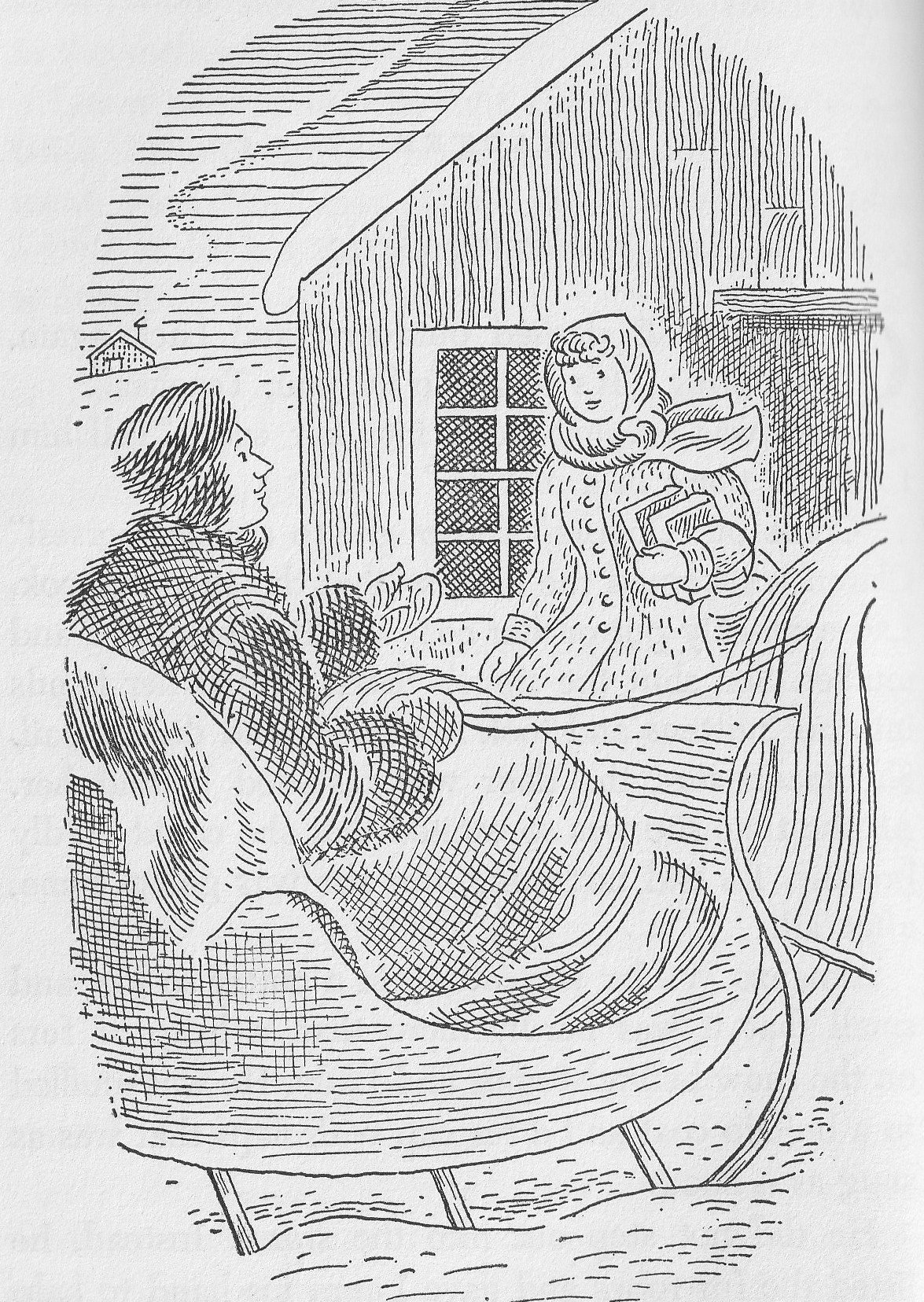
Laura Ingalls Wilder’s last Little House novel, These Happy Golden Years, includes an unforgettable chapter entitled, “A Cold Ride.” Laura, who is now a schoolteacher at the Brewster school twelve miles from home and boarding with the dysfunctional Brewster family, has just endured a harrowing experience: Mrs. Brewster waving a butcher knife over her husband’s head and threatening a murder/suicide, saying “If I can’t go home one way, I can another.”1 Laura dreads the long, perhaps dangerous weekend at the Brewster house after this experience when suddenly, despite the fierce and dangerous cold, Almanzo Wilder appears in his cutter to take her back to her family for the weekend. His appearance is even more unexpected since Laura had told him the week before that she had no interest in being courted. She had told him, “I am going with you only because I want to get home. When I am home to stay, I will not go with you any more.”2
Mr. Brewster is alarmed at the prospect of Laura and Almanzo’s twelve-mile drive back to the town of De Smet. The temperature has fallen to forty below zero. “You folks are fools to try it,” Mr. Brewster tells Laura.3
Yet Laura is so desperate to escape the Brewster household that she’s willing to risk her life. As readers of the Little House books know, Laura’s “Cold Ride” in These Happy Golden Years is not only dangerous; it’s potentially deadly. “The cold was piercing through the buffalo robes. It crept through Laura’s wool coat and woolen dress, through all her flannel petticoats and the two pairs of woolen stockings drawn over the folded legs of her warm flannel union suit. In spite of the heat from the lantern, her feet and her legs grew cold. Her clenched jaws ached, and two sharp little aches began at her temples.” But, Wilder writes, “there was nothing to do but go on….”4 Laura struggles to stay awake, to resist the inevitable urge to sleep. She knows, “If you go to sleep in such cold, you freeze to death.”5 Almanzo fights to keep Laura awake and delivers her safely home. This cold ride forges an unbreakable bond between Laura and Almanzo, and lays the foundation for their courtship and eventual marriage.
Although this episode is fictional, it is also autobiographical. Wilder had written about this experience twice before, first as a farm journalist in 1924, nineteen years before the publication of These Happy Golden Years; and then again in her memoir, Pioneer Girl, completed in 1930. Her account in Pioneer Girl also inspired yet another fictional retelling of this unforgettable “Cold Ride.” Her daughter, Rose Wilder Lane, lifted and then scrambled characters, settings, and details from her mother’s then unpublished memoir, and placed them in “Home Over Saturday,” a short story published in The Saturday Evening Post in September 1937. As we’ll see, the details in these earlier accounts shifted over time and illustrate Wilder’s creative development as a novelist and the significant ways in which her fiction differed from her daughter’s.
The Missouri Ruralist: I’ll Never Forget That Ride
In December 1924, toward the end of her eleven-year career as a columnist and editor for the Missouri Ruralist, Wilder published her first personal recollection of the “Cold Ride,” casting it as a Christmas Eve story from her past. On the surface, the column’s setting and situation are consistent with Wilder’s fictional depiction in These Happy Golden Years. Wilder tells Ruaralist readers that “This was my first school”; that it was located in Dakota Territory, “12 miles from home”; and that that this schoolhouse wasn’t really a schoolhouse at all. It had been a “summer home of a homesteader” and was so poorly constructed that snow blew “thru the cracks in its walls,” forming “little piles and miniature drifts on the floor”—and even on her students’ desks.6
But the Ruralist column differs in significant ways from Wilder’s later fictional version. She doesn’t give the school a name, nor does she specify where she boarded. She simply refers to “my boarding place.” In short, there’s no reference to a butcher knife. In this account, “Teacher,” as Wilder identifies herself here, longs to go home, not to escape a terrifying experience, but to “get home for Christmas Day.” Yet, it is “almost too cold to hope for father to come,” Wilder writes, “and a storm was hanging in the northwest which might mean a blizzard at any minute.” One other significant difference in this account: Wilder tells readers she was “only 16 years old”; in These Happy Golden Years, Laura is 15.7
From there, the Ruralist column moves back into familiar territory for Little House readers. There’s a “jingle of sleigh bells” and outside, a man “in a huge fur coat in a sleigh full of robes” passes the window. Wilder writes, “I was going home after all.” She then explains that traveling twelve miles in 1924 “means only a few minutes” by “motor car,” but it “was different then, and I’ll never forget that ride.”8 Yet Wilder doesn’t linger on the misery and danger of that cold ride as she does in These Happy Golden Years. The Ruralist column, instead, moves to a swift conclusion.
In just three very short paragraphs, she wraps up this column with a happy ending. Although she tells Ruralist readers that once she reached her destination, she was so chilled that she “had to be half carried into the house,” she was safely home for Christmas, “and cold and danger were forgotten.”9 As for the romantic tension underlying “The Cold Ride” in These Happy Golden Years, it isn’t here. Wilder simply reveals that the man in that huge fur coat “later became the ‘man of the place,’” the phrase she used to identify Almanzo to Ruralist readers.10
The column ends with a Christmas card sentiment: “Our hearts grow tender with childhood memories and love of kindred and we are better thruout [sic] the year for having in spirit become a child again at Christmas-time.”11
Despite the relative lack of drama in the Ruralist column, it may have been a turning point in Wilder’s career as a writer. It was her last column as a regular contributor and editor at the Missouri Ruralist, and perhaps it had turned her thoughts to those tender “childhood memories” and “love of kindred” that propelled her to consider writing more extensively about her pioneer past.
Pioneer Girl: Home Over Sunday
It’s unclear when Wilder began writing her memoir, Pioneer Girl, but we know when she finished her first draft. Her daughter Rose Wilder Lane recorded the date in her diary: May 7, 1930. “My mother came this afternoon,” Lane writes, “bringing her manuscript.”12
The original, handwritten draft of Pioneer Girl presents extensive details about Wilder’s initial experiences as a frontier schoolteacher in Dakota Territory, many of them consistent with the those she fictionalized thirteen years later in These Happy Golden Years. Wilder boarded with the dysfunctional Bouchie family. They lived “twelve and a half miles” south of De Smet.” Wilder’s first schoolhouse “was an abondened [sic] claim shanty, one thickness of boards with cracks between, through which the snow blew….”13 And just like Mrs. Brewster in These Happy Golden Years, Mrs. Bouchie in Pioneer Girl “was never pleasant, she was always sullen and seldom spoke,” sometimes “raging” at her husband.14 As for the infamous butcher knife scene, it makes an appearance in Pioneer Girl too. But it appears after Wilder’s cold ride home with Almanzo.
Pioneer Girl’s “Cold Ride” appears several pages before Wilder records the frightening butcher knife scene. The “youngest Wilder boy” as she identifies Almanzo here, had been taking her “home over Sunday” for the previous two months, and one of her students had taken to calling him “’teacher’s beau.’” The label rankles: “Much as I wanted to go home, I did not want to be unfair nor deceitful. I was only going with him for the sake of being home over Sunday and fully intended to stop as soon as my school was out.” She tells this to Almanzo shortly before their “Cold Ride,” and assumes that from this point on, he will “stop now and save” himself from future “long, cold drives.”15 Readers of These Happy Golden Years will recognize this element of romantic tension. Laura appears to have lost her weekly ride home to her family.
In Pioneer Girl, the cold is so intense that Mr. Bouchie cancels school that day, and Wilder must wait out the cold inside the Bouchie’s cramped and unpleasant claim shanty. The next morning, the cold continues and Mrs. Bouchie is “in an awful temper.”16 But school is in session, and Wilder escapes to the schoolhouse. “I did not have any hope of going home,” Wilder writes, “the storm was so bad and the cold so intense and I wanted so much to get away.” And then she is “completely taken by surprise “ when she hears “a dashing jingle of bells at the door….” The youngest Wilder boy has returned, despite the bitter cold, and despite the knowledge that Laura Ingalls is not interested in romance. The temperature is “forty-five below zero,” so cold the thermometers back in town have frozen.17
In this account, Wilder includes more details about this cold ride than she did in the Missouri Ruralist column. She describes her warm dress and underclothes, her petticoats and woolen stockings, her heavy coat, hood, and woolen veil. Almanzo’s “cutter (small sleigh)”is fitted out with a heavy blanket, a buffalo robe, and a “lighted lantern” to keep their feet warm. 18 But in Pioneer Girl, Wilder’s motivation to risk her life in this deadly cold is different than the one provided in the Ruralist column. She didn’t choose to take that cold ride home to be with her family at Christmas; she chose to take it to escape the general unpleasantness of Mrs. Bouchie.
Several pages later in Pioneer Girl, Wilder records the butcher knife scene—Mrs. Bouchie “screaming in fury” with “a large butcher knife in her hand,” looming over her husband, lying in bed. Wilder writes that she “was terrified,” and “lay awake the rest of the night.”19 When Wilder turned her hand to fiction in These Happy Golden Years, she created a new chronology, placing the butcher knife scene before the “Cold Ride,” and in the process increased the romantic tension in the novel and gave Laura a more compelling reason to place her life in Almanzo’s hands. It was a masterful creative decision.
Later in Pioneer Girl, when Wilder and Almanzo had become an established couple, she writes, “After all we had been through blizzards, near-murder and danger of death together…those things do create ‘a tie that binds….’”20 The drama of that cold ride and Mrs. Bouchie’s butcher knife had created an unbreakable bond between them. Their marriage lasted for sixty-four years, until Almanzo’s death in 1949. No wonder Wilder wrote and rewrote and then fictionalized this episode from her life.
Rose Wilder Lane: “Home Over Saturday”
In Pioneer Girl, Wilder adds an epilogue to the scene with Mrs. Bouchie and her butcher knife. When Wilder returns to the Bouchie household on the following Sunday night, “Things were still very wrong….” Mrs. Bouchie refuses to speak; Mr. Bouchie is in the barn and doesn’t return to the claim shanty until supper is ready. Abruptly, Mrs. Bouchie leaves the house, grabbing only her shawl as protection against the fierce and dangerous cold. As “minutes tick by,” Wilder remembers growing “uneasy” wondering if Mrs. Bouchie “would stay out until she froze….”21 Then an hour later, Mrs. Bouchie returns without injury or explanation for her alarming behavior.
In 1937, Rose Wilder Lane adapted this scene, along with others from her mother’s memoir, and placed it in her short story entitled, “Home Over Saturday.” It was published in The Saturday Evening Post, a prestigious national magazine, and illustrated with original artwork.
Lane’s short story essentially follows Wilder’s outline of events in Pioneer Girl. Lane’s retelling, however, has a different emotional focus: a love triangle and bitter rivalry between two young men. Lane’s story is melodramatic; her characters readily display and discuss their emotions. She abandons what her mother called the “stoicism of the people” on the frontier, a characteristic Wilder believed was essential to her characters and their experiences in the American West.22
Lane’s main character is fifteen-year-old Jenny Boles, who is loosely based on Wilder herself. Jenny is enamored with a young man named Len Gardner, a stand-in for Cap Garland. Little House readers know Cap as the handsome, athletic, and courageous young man who makes his first appearance in The Long Winter. In “Home Over Saturday,” however, Len Gardner works at the bank and is “strong and brave and ruthless. If he had been an outlaw, she [Jenny] would have gone with him, riding, raiding, loading his guns while he fought it out with the sheriff, and dying with him.”23 Even after he forcibly tries to kiss her, Jenny regrets that she isn’t engaged to Len when she leaves to teach school twenty miles away.
The Almanzo character in “Home Over Saturday” is a young homesteader, Hogan Williams, who (like Almanzo) filed on his claim when he was under-age and fears Gardener will reveal his secret. As the story opens Hogan, still not yet twenty-one, has worked his claim for almost four years and has recently harvested a profitable wheat crop. He has saved enough to build a proper house. But he could lose everything to Len, who appears to be waiting for his own twenty-first birthday, when he can disclose Hogan’s secret and take over the claim himself. As Len tells Jenny, anyone could file claim on Hogan’s place “and take it out from under him slick as a whistle. All you’d have to do is prove he’s got no legal right to it. A man can’t file on a claim till he’s twenty-one, or married; that’s the law.’”24
Meanwhile, Jenny has begun teaching school, and boards with the unhappy Mr. and Mrs. Hite, the Bouchie/Brewster counterparts in Lane’s retelling. There aren’t any children in the Hite household. Their two boys were killed in a tornado almost two years before (another detail Lane borrows from an unrelated Pioneer Girl episode, and which Wilder herself uses in These Happy Golden Years). Mrs. Hite is haunted by her sons’ deaths. In “Home Over Saturday,” she suffers from grief and shock, triggered by the sound of the wind on the open prairie. Her behavior makes Jenny “anxious” and uncomfortable. At one point, Mrs. Hite squeezes Jenny’s wrist with such force that it turns “purple-black” overnight. 25
Jenny dreams of home, but in Lane’s version of this story, she’ll have to wait four months before seeing her family again. Then to her surprise, Hogan arrives on the third Friday of her term. From the schoolhouse, she glimpses a buggy and assumes it’s Len. Then she sees Hogan. He sees “her face go blank” and “his high spirits” fall flat.26 Yet Friday after Friday, Hogan returns for Jenny and she accepts one ride after another, even as wintery weather descends. But she remains interested in Len, and on an especially cold ride back to the Hite household, Jenny tells Hogan, “’I’m going with you only to get home over Saturday… and when I get home to stay I won’t go with you any more.’”27 This line is almost identical to Wilder’s memory of her conversation with the youngest Wilder boy in Pioneer Girl.
But Lane adds additional dialogue to this scene, revealing her characteristic approach to pivotal scenes in her work: the emotional outburst. Hogan is crushed by Jenny’s declaration and “burst out, ‘But why? Why do you feel this way about me?’’ She then admits there’s “’somebody else.’”28
“Home Over Saturday” then shifts to town, where Hogan and Len duke it out in front of the barber shop, resolving nothing. This scene is only one of two scenes completely unique to Lane’s retelling of her mother’s “Cold Ride.”
Back at the Hite household, Mrs. Hite waves a butcher knife over her husband’s bed, Jenny watches in fear, and mentally recites the Twenty-Third Psalm to steady herself. Hogan doesn’t appear to rescue Jenny from this trauma, and life goes on in the unpleasant Hite household. Jenny’s real terror of Mrs. Hite, however, comes the following week on a brutally cold afternoon. Jenny has dismissed school early and trudged back to the Hite household. Suddenly Mrs. Hite tears off her clothes and runs outside into the cold, a much more dramatic scene than the episode that inspired it in Pioneer Girl. Jenny responds predictably—or as predictably as Lane’s characters so often do—with an emotional outburst and more melodrama. She breaks down completely: Jenny “could not help crying, she had gone weak, a spineless thing, helplessly, shamefully crying.”29 Eventually, Mr. Hite returns, carrying his wife; she’s wrapped in a buffalo robe.
The next morning, Hogan inexplicably decides to drive out to the Hite homestead to bring Jenny back to town The thermometer has dropped to “forty below zero.” He finds Jenny, not at the schoolhouse, but at the Hite shanty. Although now Mrs. Hite is “sick,” and the “’wind’s under fifty below zero,’” Jenny decides she wants to leave with Hogan.30
Lane devotes a few sentences to Jenny’s layers of warm clothes and a paragraph about Hogan’s attempts to warm his sleigh. Still, the wind takes Jenny’s breath away; it strikes “her body as if she were naked.” Despite the fierce cold, Hogan and Jenny have a lengthy and emotional conversation on the drive home. When she tells him she didn’t expect him to drive her home ever again, he responds with an angry outburst: “’What kind of cur do you take me for?’ he shouted roughly. ‘Think I’d let you stay out here homesick, just because there’s nothing in it for me?’”31
The story comes to a swift and unexpected conclusion. Safely home after this cold ride, Jenny is put to bed. Hogan stops at the Boles home later to check on her, and is ushered into her bedroom, the second scene that’s completely unique to “Home Over Saturday.” Jenny is propped up in bed, wearing a “cotton-flannel nightgown,” her “beautiful” hair in a single braid, resting on a “patchwork quilt.”32 It’s hard to imagine that any respectable nineteenth century family, no matter how indebted they might feel to a young man, would give him access to their daughter’s bedroom. But Lane’s characters aren’t necessarily drawn with the same attempt at historical authenticity as her mother’s.
Without any encouragement from Hogan, Jenny then announces that she’ll marry him tomorrow so he can legally lay claim to his homestead and avoid losing it to Len. Despite her sudden decision, “Home Over Saturday” ends as Jenny shrinks “down small into the pillow” and covers “her face with her hands,” too embarrassed to admit that she has had a change of heart, a change sparked by that cold ride.33
These Happy Golden Years: Romantic Chemistry
By far, the “Cold Ride” in These Happy Golden Years is the strongest and most compelling of Wilder’s accounts of this episode in her life. Lane’s version pales in comparison. She may have lifted the setting, snippets of dialogue, one detail after another, and even the characters themselves from Pioneer Girl, but unlike her mother, Lane was unable to breathe life into her retelling. “Home Over Saturday” lacks, not just the authenticity of that cold ride, but the romantic chemistry Wilder creates between the fictional Laura and Almanzo in These Happy Golden Years. Despite the pioneer stoicism Wilder employs throughout her Little House books, they’re grounded in an emotional realism that Lane was unable to unlock. There’s a magic to Wilder’s “Cold Ride” that Lane couldn’t conjure in hers.
Notes
1. Laura Ingalls Wilder, These Happy Golden Years, 65.
2. LIW, These Happy Golden Years, 65.
3. LIW, These Happy Golden Years, 70.
4. LIW, These Happy Golden Years, 72.
5. LIW, These Happy Golden Years, 74.
6. LIW, “As a Farm Woman Thinks, Missouri Ruralist, December 15, 1924, in Laura Ingalls Wilder: Farm Journalist, Stephen W. Hines, ed., 311.
7. LIW, “As a Farm Woman Thinks,” in Hines, 311.
8. LIW, “As a Farm Woman Thinks,” in Hines, 311.
9. LIW, “As a Farm Woman Thinks,” in Hines, 312.
10. LIW, “As a Farm Woman Thinks,” in Hines, 311.
11. LIW, “As a Farm Woman Thinks,” in Hines, 312.
12. Rose Wilder Lane, Diary #25, May 7, 1930, Lane Papers, Herbert Hoover Presidential Library.
13. LIW, Pioneer Girl: The Annotated Autobiography, Pamela Smith Hill, ed., 260.
14. LIW, Pioneer Girl, 263.
15. LIW, Pioneer Girl, 264.
16. LIW, Pioneer Girl, 266.
17. LIW, Pioneer Girl, 267.
18. LIW, Pioneer Girl, 263, 266.
19. LIW, Pioneer Girl, 270.
20. LIW, Pioneer Girl, 297.
21. LIW, Pioneer Girl, 270.
22. LIW to RWL, March 7, 1938, Lane Papers, Herbert Hoover Presidential Library.
23. RWL, “Home Over Saturday,” The Saturday Evening Post, September 11, 1937, 7.
24. RWL, “Home Over Saturday,” 7.
25. RWL, “Home Over Saturday,” 53.
26. RWL, “Home Over Saturday,” 54.
27. RWL, “Home Over Saturday,” 57.
28. RWL, “Home Over Saturday,” 57.
29. RWL, “Home Over Saturday,” 60.
30. RWL, “Home Over Saturday,” 60.
31. RWL, “Home Over Saturday,” 60.
32. RWL, “Home Over Saturday,” 60.
33. RWL, “Home Over Saturday,” 60.